Free
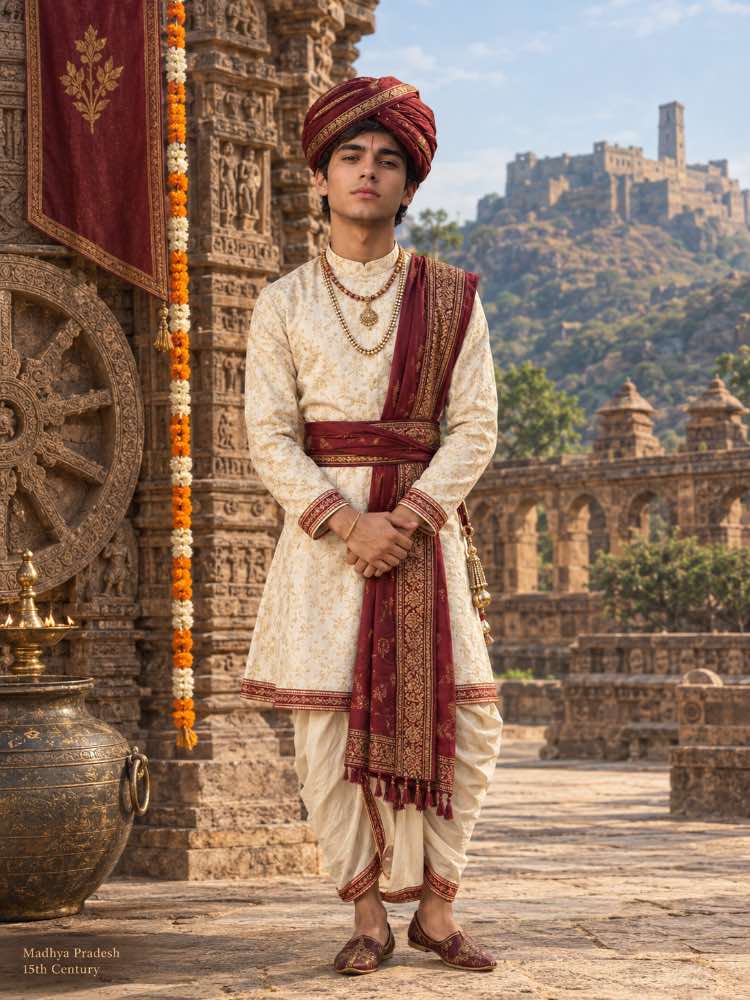
Example result — yours keeps your own face.
Madhya Pradesh Noble Boy in Traditional Royal Attire
Create a realistic 15th century Madhya Pradesh noble boy in traditional royal attire with turban, gold jewelry and a historic fort palace setting.
2 views♥ 61 savesAdded
Prompt · 2,292 words
# Exact 15th-Century Madhya Pradesh Noble Boy Portrait Recreation Prompt — Self-Contained — 3:4 Vertical

Create a premium, ultra-photorealistic full-body historical cultural portrait of ONE noble Indian boy from 15th-century Madhya Pradesh, standing inside an ornate medieval central Indian palace or temple courtyard.

IMPORTANT:
The original reference image will NOT be supplied during generation.

Therefore, this written prompt must act as the COMPLETE visual source of truth for the boy’s clothing, turban, jewelry, footwear, pose, architecture, distant hill fort, composition, camera angle, lighting, color palette, and historical atmosphere.

The final image must closely match the described scene and must look like a genuine high-end DSLR or medium-format photograph of an authentic historical reconstruction.

Do NOT create:
- a painting
- a miniature artwork
- fantasy prince styling
- modern Indian wedding clothing
- Mughal clothing from a later century
- modern sherwani styling
- theatrical costume
- CGI
- obvious AI imagery

Use a STRICT 3:4 vertical portrait composition.

==================================================
MANDATORY IDENTITY WORKFLOW
==================================================

Before generating, check whether the user has already uploaded ONE clear photograph of the child whose identity should appear.

If no suitable identity photo has been uploaded, STOP and ask only:

“Please upload one clear photo of the child with the face clearly visible.”

Do NOT generate the final portrait without the child photo.

Once uploaded, use that image ONLY as the identity reference.

Preserve the child’s exact recognizable facial identity:
- face shape
- forehead
- hairline
- eyebrow shape
- eye shape and spacing
- nose structure
- lips
- cheeks
- jawline
- chin
- ears
- natural skin tone
- natural age
- natural facial proportions

The final person must look like ONE naturally photographed child.

ABSOLUTELY NO pasted-face or attached-head appearance.

The face, scalp, ears, neck, shoulders, body, lighting, skin texture, perspective, head size, and anatomy must integrate naturally as if photographed together in-camera.

==================================================
SUBJECT
==================================================

Show ONE Indian boy approximately 8–11 years old.

He has:
- slim, age-appropriate body proportions
- medium-brown Indian skin tone
- soft natural child facial features
- calm, dignified expression
- direct eye contact with the camera
- closed relaxed lips
- composed posture
- no exaggerated smile

He stands upright, slightly turned approximately 5–10 degrees from perfectly frontal while his face remains nearly straight toward the camera.

His shoulders remain relaxed.

His hands are gently clasped together in front of his lower abdomen.

Right hand resting naturally over the left hand.

Do not make the pose stiff or theatrical.

==================================================
EXACT HEADWEAR
==================================================

Dress the boy in an elaborate traditional wrapped turban.

The turban must be:
- deep maroon / dark brick-red fabric
- layered and hand-wrapped
- moderately large but proportional to the child’s head
- slightly asymmetric natural folds
- decorated with narrow antique-gold woven borders
- subtle traditional geometric and floral woven detailing
- no giant plume
- no jeweled Mughal sarpech
- no modern groom ornament

A small section of his natural dark black hair must remain visible around the forehead, temples, and ears.

Hair:
- medium-short
- soft
- slightly wavy
- natural child hair texture

Place a very small subtle vertical tilak/bindi mark at the center of his forehead.

==================================================
EXACT UPPER GARMENT
==================================================

The boy wears a luxurious cream / warm ivory long-sleeved historical court tunic.

The garment must closely follow this construction:

- high round neckline
- long fitted sleeves
- moderately fitted upper torso
- gently flared lower skirt
- hem ending around mid-thigh to just above the knee
- elegant traditional cut
- no modern buttons visible

Fabric:
- warm ivory / cream
- fine silk or silk-cotton appearance
- subtle woven texture
- covered throughout with very delicate muted antique-gold floral and vine motifs

The pattern must remain refined and understated, not bright yellow metallic embroidery.

Cuffs:
- narrow decorative antique-gold and maroon border
- intricate miniature geometric patterning

Lower hem:
- matching narrow maroon-and-antique-gold decorative border
- finely woven traditional motifs

Do NOT replace this garment with a modern sherwani, kurta pajama, achkan, or wedding costume.

==================================================
LOWER GARMENT
==================================================

Under the tunic, the boy wears a traditional cream dhoti-style lower garment.

It must have:
- voluminous but controlled draping
- gathered folds around thighs
- tapered wrapping toward calves
- historically styled fabric construction
- warm ivory / cream color
- subtle woven texture

Along the outer folds and lower edges, include a narrow traditional maroon-and-antique-gold woven border.

The dhoti should stop above the ankles, leaving a small section of ankle visible.

Do not make it look like modern salwar pants.

==================================================
MAROON DRAPED SASH
==================================================

A very important visual element is the deep maroon textile draped around the boy.

Use a rich dark maroon / rust-red woven silk sash with antique-gold patterned borders.

The sash must be arranged in three connected areas:

1. One section drapes from the boy’s LEFT shoulder downward across the torso.
2. A wide section wraps firmly around his natural waist like a traditional kamarband.
3. A long vertical panel hangs down the center-front of his body to approximately knee level.

The hanging sash must include:
- antique-gold woven border running vertically
- traditional floral / geometric woven motifs
- richly patterned broader bottom border
- short natural fabric tassels at the end

The sash must feel heavy, real, and historically woven.

Do not make it bright red.

Keep the tone deep maroon, burgundy-rust, and earthy red.

==================================================
JEWELRY
==================================================

Add restrained noble-child jewelry.

Around his neck:
- two short antique-gold necklaces
- one finer chain
- one slightly heavier beaded or linked necklace
- one small antique-gold ornamental pendant positioned at upper chest

Jewelry should appear handcrafted and historical.

No oversized gemstones.

No diamond-heavy bridal jewelry.

On one wrist:
- one very thin antique-gold bracelet

At the sash/waist area:
- a small antique-gold decorative ornament or hanging metal accessory can be visible along the left side

All metal should have a slightly aged warm-gold finish rather than modern polished yellow gold.

==================================================
FOOTWEAR
==================================================

The boy wears traditional closed-toe embroidered leather jutti / mojari shoes.

Shoes:
- dark brown to muted burgundy leather
- gently upturned pointed toes
- intricate antique-gold embroidery
- fitted traditional shape
- low profile
- authentic handmade appearance

No sandals.
No modern shoes.

==================================================
EXACT POSE
==================================================

Full-body standing pose.

Feet:
- slightly separated
- one foot positioned subtly ahead of the other
- feet naturally angled rather than perfectly parallel

Body:
- nearly frontal
- very slight rotation
- relaxed shoulders

Hands:
- both hands clasped calmly at waist/lower-abdomen level
- elbows gently bent
- no object held

Head:
- upright
- chin neutral
- face directed almost exactly toward camera

Expression:
- composed
- calm
- dignified
- slightly serious
- believable child expression

==================================================
PALACE / TEMPLE ARCHITECTURE
==================================================

Place the boy inside an elaborate medieval stone palace or temple courtyard inspired by historical Madhya Pradesh architecture.

Immediately behind and LEFT of the boy should be a richly carved sandstone architectural structure.

Include:

- tall carved stone column
- intricate geometric jali-like carving
- floral relief work
- layered rectangular panels
- recessed carvings
- aged warm beige / sandstone surface
- believable centuries-old erosion and weathering

The carved column occupies much of the left-middle background.

Directly behind him should be deeper shadowed interior architecture.

==================================================
LEFT-SIDE FABRIC BANNER
==================================================

Along the upper-left side of the composition, hang a large vertical fabric banner.

Banner:
- dark muted maroon / brick-red
- slightly faded historic textile
- narrow antique-gold border
- single simple gold floral / plant emblem near the upper region
- gently hanging natural fabric
- small tassel at the lower corner

The banner should hang from the building and occupy a noticeable portion of the upper-left background.

==================================================
LARGE METAL VESSEL
==================================================

In the lower-left foreground, place a large antique bronze/brass storage vessel.

It should be:
- rounded
- broad-bellied
- heavy
- aged bronze/brass
- engraved or embossed decorative pattern
- dark tarnish and patina
- two visible metal ring handles

The vessel sits partially cropped by the left frame edge.

It must feel historically plausible, not decorative hotel décor.

==================================================
DISTANT FORT BACKGROUND
==================================================

The RIGHT half of the background opens toward an outdoor landscape.

Show a distant large stone hill fort sitting high on a rocky ridge.

The fort should appear:
- historic
- weathered
- pale brown / gray sandstone
- partially ruined
- multiple irregular walls and towers
- one taller vertical tower visible
- softened slightly by atmospheric haze

Below the fort:
- rocky hillside
- sparse scrub vegetation
- muted green-brown landscape

The fort must remain clearly identifiable as a distant historical hill fortress without becoming overly sharp.

==================================================
MIDGROUND COURTYARD
==================================================

Between the boy and the distant hillside, include:

- old stone courtyard walls
- repeating shallow arch or crenellated shapes
- warm weathered sandstone
- sparse small trees and shrubs
- stepped stone platforms
- low carved architectural blocks

Do not overcrowd the environment.

==================================================
GROUND
==================================================

The boy stands on an ancient stone courtyard floor.

The ground should contain:
- large irregular sandstone slabs
- visible joints between stones
- cracked sections
- worn edges
- subtle dusty texture
- warm beige and muted brown tones
- believable historical age

Strong natural sunlight creates soft directional shadows across the floor.

==================================================
COMPOSITION
==================================================

Use a strict 3:4 vertical portrait.

Show the boy from turban to feet with his entire body visible.

Approximate positioning:
- boy centered slightly RIGHT of the middle axis
- head around upper third
- feet around 91–94% frame height
- small but clear floor space under shoes
- no cropped turban
- no cropped feet

The boy should occupy approximately 72–78% of the vertical frame.

The carved architecture dominates the LEFT side.

The fort and open landscape fill the upper-right background.

The large bronze vessel remains at lower-left.

Keep the composition balanced and nearly identical to an editorial historical portrait.

==================================================
CAMERA
==================================================

High-end full-frame DSLR or medium-format photography.

Suggested look:
- 70–85 mm equivalent lens
- approximately 80 mm ideal
- camera around the child’s upper torso / chest height
- distance sufficient for a natural full-body portrait
- no wide-angle distortion
- vertical camera orientation
- no Dutch angle
- roll 0 degrees

Camera points almost straight toward the subject.

Use a gently shallow depth of field:
- child sharply focused
- nearby carved stone still well resolved
- distant fort softly blurred but recognizable

Approximate aperture:
f/4–f/5.6

Natural optical perspective only.

==================================================
LIGHTING
==================================================

Use warm late-morning or early-afternoon natural sunlight.

Primary light comes from the upper-right/front-right side.

The light should create:
- soft warm highlights on the boy’s right-facing surfaces
- subtle modeling across the face
- realistic gentle shadows beneath the turban
- natural shadows under chin
- dimensional fabric folds
- soft ground shadows toward the left

Keep skin tones natural.

Do not use dramatic studio rim lighting.

Do not make the scene orange.

The lighting should feel like real Indian daylight softened slightly by the surrounding stone architecture.

==================================================
COLOR PALETTE
==================================================

Strictly preserve this palette:

- warm ivory
- cream
- antique gold
- deep maroon
- burgundy-rust
- warm sandstone
- aged bronze
- muted earth brown
- dusty muted greens
- pale blue sky

Avoid:
- bright synthetic reds
- neon colors
- modern saturated fabrics
- excessive orange grading
- teal-and-orange cinematic grading

==================================================
PHOTOREALISM
==================================================

Highest priority: REAL PHOTOGRAPH.

Render:
- authentic child skin texture
- tiny pores
- subtle peach fuzz
- natural lips
- individual eyelashes
- real hair strands
- realistic textile fibers
- physically accurate cloth folds
- authentic embroidery
- slightly tarnished jewelry
- stone weathering
- dust
- scratches
- natural light falloff
- realistic depth of field

The child must retain age-appropriate proportions.

Do not make him look like an adult with a child-sized body.

No beauty-filter skin.
No porcelain face.
No over-sharpening.
No synthetic glow.
No plastic textile.
No fake symmetry.

==================================================
BOTTOM-LEFT TEXT
==================================================

Place small elegant historical caption text in the LOWER-LEFT corner.

Text exactly:

Madhya Pradesh
15th Century

Formatting:
- two separate lines
- elegant small serif font
- antique muted gold / warm beige text
- subtle
- unobtrusive
- left aligned
- positioned just above the bottom edge
- no text box
- no heavy shadow
- no modern typography

==================================================
STRICT NEGATIVE RULES
==================================================

Do NOT:
- change the cream-and-maroon clothing combination
- remove the maroon sash
- change the turban color
- replace the dhoti
- modernize the clothing
- use modern sherwani styling
- use generic Bollywood prince styling
- add a sword
- add weapons
- add a crown
- add a jeweled plume
- add modern furniture
- add modern buildings
- add random people
- add vehicles
- make the fort dominate the portrait
- crop the shoes
- crop the turban
- alter the child’s uploaded face
- create a pasted face
- mismatch head and body
- change natural skin tone
- make the child older
- use fantasy architecture
- turn the scene into a painting
- create CGI
- create an illustration
- over-saturate colors

FINAL RESULT:
A museum-quality, ultra-photorealistic historical portrait of a noble 15th-century Madhya Pradesh boy in an ivory-and-antique-gold court tunic, cream dhoti, deep maroon woven sash and matching turban, antique jewelry and embroidered mojari, standing calmly with clasped hands in an intricately carved sandstone palace courtyard, with a large aged bronze vessel at lower-left and a softly focused ancient hill fort rising in the distant right background.

It must look like a real child genuinely photographed inside a historically reconstructed 15th-century central Indian environment, with seamless identity integration and absolutely no attached-face appearance.
How to get the best result
- 01📸 Upload one clear, well-lit face photo as the identity reference.
- 02😊 Keep the original facial features and natural skin texture.
- 03✨ Use ChatGPT or Gemini image generation and pick the highest quality.
Pro Want even more detailed prompts?
Unlock every Pro prompt from ₹99 — no auto-renewal.
Keep exploring
More culture prompts.
Culture
Korean Nobleman in Traditional Joseon Attire
Free
Korean Nobleman in Traditional Joseon Attire
Culture2
Culture
Naga Tribal Woman in Traditional Nagaland Attire
Free
Naga Tribal Woman in Traditional Nagaland Attire
Culture2
Culture
Norwegian Viking Warrior in Traditional Norse Attire
Free
Norwegian Viking Warrior in Traditional Norse Attire
Culture2
Culture
Roman Noblewoman in Traditional Imperial Attire
Free
Roman Noblewoman in Traditional Imperial Attire
Culture1
Culture
Indonesian Nobleman in Traditional Royal Attire
Free
Indonesian Nobleman in Traditional Royal Attire
Culture1
Culture
French Medieval Girl in Traditional Noble Dress
Free
French Medieval Girl in Traditional Noble Dress
Culture1
Culture
Greek Nobleman in Traditional Byzantine Royal Attire
Free
Greek Nobleman in Traditional Byzantine Royal Attire
Culture1
Culture
Traditional Kashmiri Couple Portrait
Free
Traditional Kashmiri Couple Portrait
Culture1