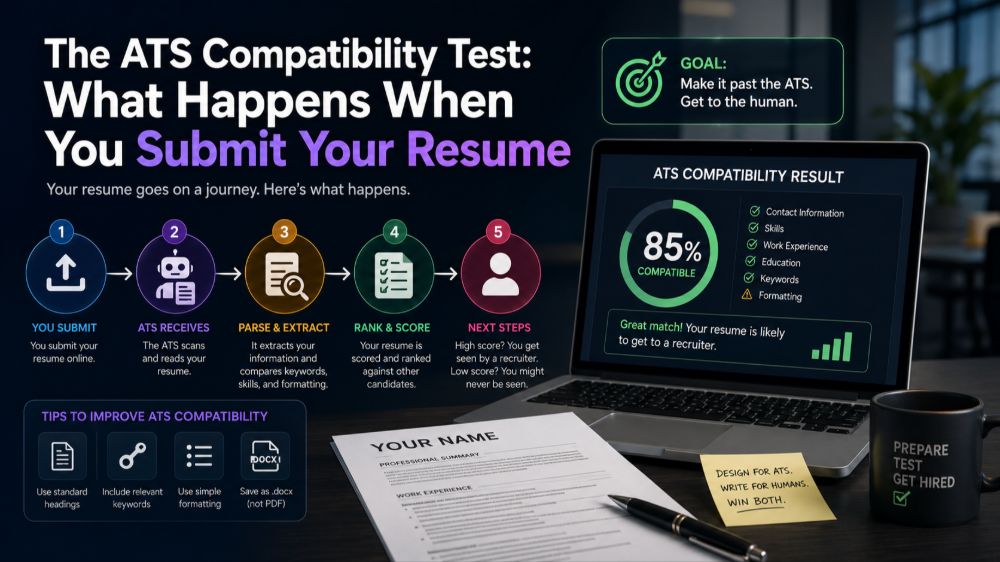
The Real Problem With ATS Rejection
You've heard the advice: "Use keywords from the job description to pass ATS filters." But here's what most people miss—it's not about stuffing random buzzwords into your resume. The problem is semantic mismatch: your resume describes the same skill or experience using completely different language than what the hiring manager used in the job posting.
When a job posting says "proficient with Figma," but your resume says "design tool experience," an ATS may not flag it as a match, even though you clearly have the skill. The algorithm is looking for specific term overlap, not human interpretation.
How To Find The Right Keywords Before You Write
Don't start writing your resume and then hunt for keywords. Reverse the process.
Gather at least 5-7 similar job postings for your target role (not just one). Open them all in separate browser tabs. Read through each one and create a keyword spreadsheet with these columns:
- Technical Skills (software, programming languages, tools)
- Job Titles Within Your Experience (the exact titles they use: "Growth Marketing Manager" vs. "Marketing Coordinator")
- Action Verbs (did they say "drove" or "increased" or "optimized"?)
- Industry Terms (does this field prefer "pipeline" or "funnel"? "Client" or "customer"?)
- Soft Skills As Stated ("cross-functional collaboration" vs. "teamwork")
- Metrics They Care About (revenue, engagement rate, time-to-hire, NPS)
You'll start seeing patterns. If 6 out of 7 postings mention "stakeholder management," that phrase belongs on your resume if you've done that work. If they all say "managed team of X," use that structure, not "led group of X people."
Precision Placement: Where Keywords Actually Matter Most
Not all sections of your resume are equally scanned by ATS systems.
- Job title (highest priority): Use the job category they're hiring for, even if your official title was different. If you were a "Marketing Coordinator" but the role you're applying for is "Growth Marketing Manager" and you did growth marketing work, consider leading with the functional title.
- First bullet under each role (very high priority): Place your most relevant keyword-rich accomplishment here. ATS often weights the opening statements heavily.
- Skills section (high priority): List exact tool names, software, frameworks. Spell them correctly and match capitalization ("Python" not "python").
- Job descriptions (medium priority): Use keywords naturally in context, but don't force them. One or two per bullet point is ideal.
- Header/summary (lower priority): Nice to include keywords, but less critical for filtering.
The One-To-One Matching Exercise
Here's a tactical exercise that takes 20 minutes and genuinely works:
Take the job posting. Highlight every skill, tool, or responsibility listed. Then, in a separate document, write down which bullet point on your resume addresses each requirement. If you have skills they want but nothing on your resume mentions them, you need to rewrite a bullet point to include them.
Example:
- Job Posting Says: "Experience with A/B testing and statistical analysis"
- Your Current Resume Says: "Ran marketing experiments to improve conversion rates"
- Revised Bullet: "Conducted 15+ A/B tests using statistical analysis, improving conversion rate by 23% and informing go/no-go decisions for $2M in marketing spend"
Notice the revision isn't longer—it's more specific and uses their exact terms.
Verify Your Resume Actually Passes ATS
Before submitting, paste your resume into a free ATS checker tool. Several exist online; they'll flag formatting issues and missing keywords. This isn't foolproof, but it catches obvious problems like:
- Headers or footers being cut off during parsing
- Bullet points that appear as lines of text instead of discrete items
- Skills that appear nowhere on the resume despite being critical for the role
One additional step: save your resume as a .docx or .pdf (ask the employer which they prefer). Some systems parse these differently, and a beautiful .pdf might become garbled text in an ATS.
Keywords Aren't Enough—Context Still Matters
This is important: keyword matching gets your resume in front of a human. It doesn't get you the job. Once a recruiter or hiring manager reads it, they're looking for clarity, proof of impact, and evidence you can do the work.
A resume loaded with keywords but vague on results ("Responsible for marketing initiatives") will fail in human review. A resume with strong keywords and specific metrics ("Increased organic traffic 45% by implementing SEO strategy across 200+ blog posts") will advance.
The goal is to pass the filter and then prove yourself in the text.
Your Next Step
Start your next application by researching keywords first, before you touch your resume. Spend 15 minutes building that spreadsheet. You'll write faster, match better, and actually hear back from ATS systems instead of disappearing into the void. The best resume is one that reaches human eyes—and this approach ensures it does.
If you're building a resume from scratch or want to see how strong examples are structured, you can browse real resume samples by job title on Nohaya to understand how language and keywords differ across roles and industries.