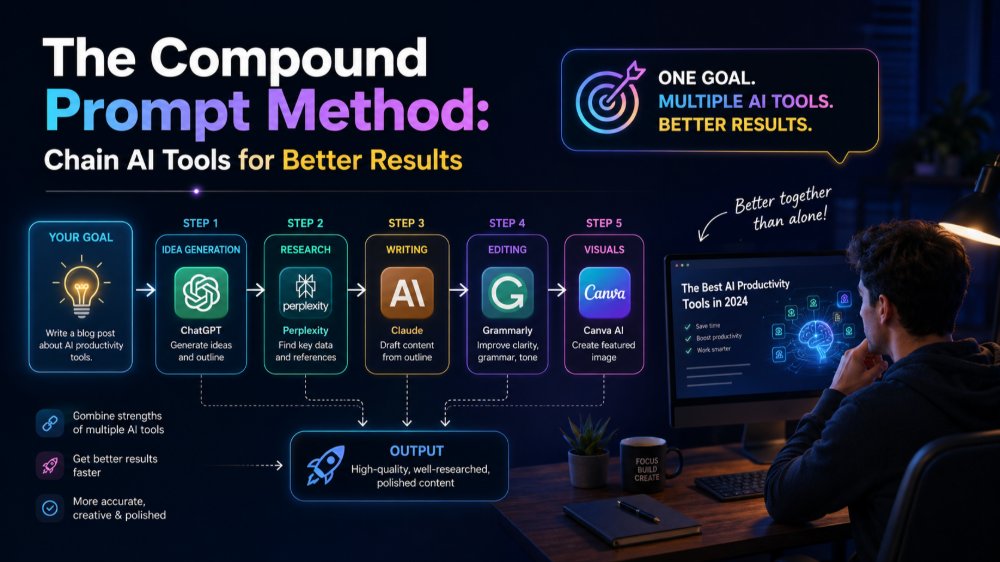
Why Single Prompts Fall Short
Most people treat AI tools like vending machines: insert prompt, receive output, hope for the best. When the result disappoints, they either give up or spend hours tweaking a single prompt. There's a better approach that professional creators use daily—compound prompting.
Compound prompting means using the output from one AI tool as refined input for another, or building results through strategic sequences rather than one-and-done attempts. This approach leverages each tool's strengths while compensating for their weaknesses.
The Three-Stage Image Creation Pipeline
Instead of throwing a complex idea directly at Midjourney or DALL-E, break your creative process into distinct stages.
Stage 1: Concept Refinement with ChatGPT
Start by describing your rough idea to ChatGPT in plain language. Ask it to analyze and expand your concept into specific visual elements:
Prompt: "I want to create an image of productivity. Help me develop this into concrete visual elements, mood, and composition details."
ChatGPT will suggest specific objects, lighting conditions, color palettes, and compositional approaches you hadn't considered. It transforms vague concepts into concrete details.
Stage 2: Technical Translation
Next, ask ChatGPT to convert that refined concept into an optimized prompt for your specific image generator:
"Now convert this concept into a detailed Midjourney prompt using appropriate style parameters and weights."
This produces technical prompts with proper syntax, parameter formatting, and keyword prioritization specific to your chosen tool.
Stage 3: Iterative Refinement
Generate your image, then describe what worked and what didn't back to ChatGPT. It can suggest specific parameter adjustments or rewrites to fix issues.
This three-stage process consistently produces better results than wrestling with image generators directly.
Cross-Pollinating Between Language Models
Different AI models have different strengths. Gemini excels at nuanced analysis and document understanding. ChatGPT handles conversational context beautifully. Claude tends toward detailed, structured explanations.
Try this compound approach for complex research:
- Use Gemini to analyze and summarize multiple sources or documents
- Feed those summaries to ChatGPT to identify patterns and generate strategic insights
- Ask Claude to structure those insights into detailed implementation plans
Each model refines and builds on the previous output. The final result incorporates multiple AI perspectives, reducing individual model biases and blind spots.
The Reverse Engineering Technique
When you find an AI-generated image or text you love, reverse engineer it through compound prompting.
Upload or describe the desired output to ChatGPT (or Gemini for images) and ask: "Analyze this result. What prompt would generate something similar? Break down the visual elements, style, and technical parameters."
The AI becomes a prompt teacher, helping you understand what makes effective prompts work. Save these analyses—they become your personal prompt library.
Prompt Forking for Exploration
Instead of perfecting a single prompt, create deliberate variations that explore different angles:
Original concept: A website hero image for a travel blog
Fork 1: Emphasize emotion and human connection Fork 2: Focus on dramatic landscapes Fork 3: Highlight adventure and action Fork 4: Create calm, aspirational mood
Generate all four variations, then use ChatGPT to analyze which elements work best across versions. Create a final "hybrid" prompt that combines the strongest elements.
This exploration approach finds unexpected creative directions you wouldn't reach through linear refinement.
The Specification Ladder Strategy
Start extremely general, then progressively add specificity across multiple generations.
Round 1: Basic concept with minimal details Round 2: Add mood and style guidance Round 3: Introduce technical parameters Round 4: Fine-tune composition and emphasis
This prevents the common problem of over-specifying too early, which can confuse AI tools or create conflicting instructions. Each round builds naturally on the previous foundation.
Building Your Compound Prompt System
Document successful compound sequences in a simple template:
- Goal: What you're trying to create
- Tool sequence: Which AIs you used in order
- Key prompts: The specific instructions at each stage
- Why it worked: What made this sequence effective
After documenting 10-15 successful sequences, patterns emerge. You'll notice which combinations work reliably for different creative goals, building your personal prompt engineering methodology.
Making It Practical
Compound prompting requires slightly more time upfront but dramatically reduces frustrating iteration cycles. Instead of generating 50 mediocre variations from a struggling prompt, you might generate 8-10 progressively better results through intentional sequencing.
Start simple: try the three-stage image pipeline this week. Once comfortable, experiment with cross-pollinating between language models. Within a month, you'll naturally think in sequences rather than single shots.
The most powerful AI results come not from perfect individual prompts, but from strategic combinations that leverage each tool's unique strengths. Whether you're creating images, writing content, or solving complex problems, compound prompting transforms AI tools from unpredictable wildcards into reliable creative partners. Explore ready-to-use AI prompts and discover more techniques like these on Nohaya PromptAi.